
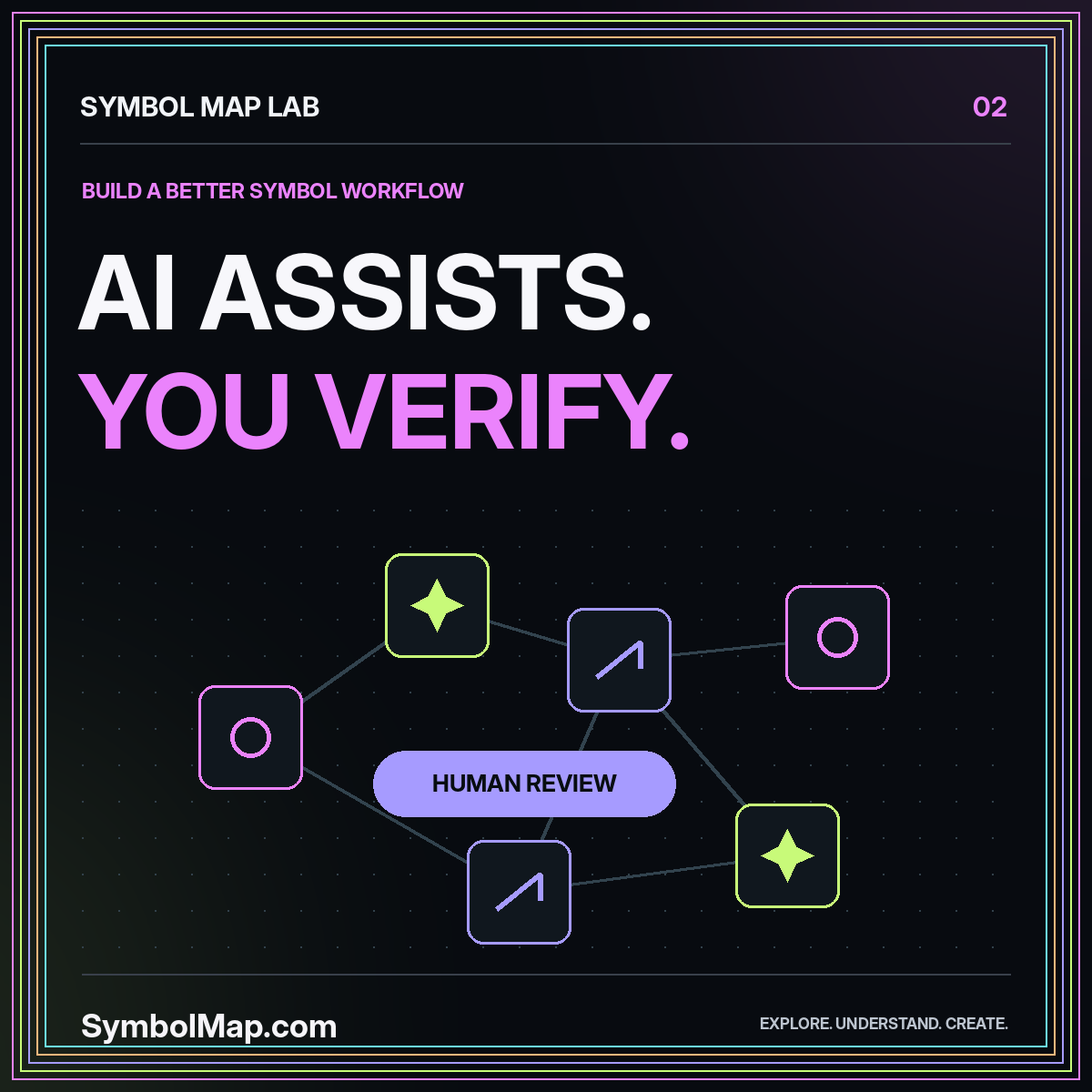
An AI symbol map is most useful as an assisted research workflow, not an automatic dictionary of meanings. A model can propose labels, suggest groups, or help format notes. The finished map still needs a person to decide which relationships are supported and which are merely plausible descriptions of similar shapes.
Consider a fictional design team organizing forty original icons for a learning application. The team wants to find redundant drawings, identify missing actions, and create consistent labels. That bounded assignment is easier to inspect than asking a model to identify every symbol in an unknown image. It also allows you to judge the result against records you already control.
Define the decision before using the model
Write down the actual decision the map should support. “Choose a consistent navigation family” is actionable. “Discover the hidden meaning of these symbols” leaves both the scope and the standard of evidence unclear. A model cannot resolve an undefined research question simply by producing a confident explanation.
Choose the output format at the same time. For the learning application, a table with an identifier, visible features, proposed action, and review note is enough. There is no need to request a network diagram until you know what its edges will represent. Separating the data from its presentation also makes corrections cheaper.
State what the model must not do. It should not invent origins, assign religious identities from visual resemblance, or treat a suggested label as a verified source. Boundaries are part of the task specification, not an afterthought added when the answer looks wrong.
Prepare a clean input collection
Use assets you are permitted to process and remove unnecessary private information. A screenshot can include client names, unpublished copy, or internal comments that have nothing to do with the icon being studied. Crop or redact those details before choosing whether to send the material to an external service.
Assign stable identifiers and keep originals outside the experiment folder. Export consistent previews with similar dimensions and backgrounds. Otherwise, the model may group icons by a presentation artifact, such as a colored card, rather than by their actual geometry. Record any transformations you applied so a reviewer can return to the unmodified source.
Keep a text manifest alongside the images. Include known names, intended functions, and which fields are unknown. When the model receives reliable context, it does not need to reconstruct that context from the pixels. More importantly, you can distinguish your supplied facts from its suggestions.
Ask for observations before interpretations
Begin with a narrow prompt: describe visible geometry, count major components, note enclosure and symmetry, and do not infer cultural meaning. This produces a description layer you can compare directly with the image. Even a simple observation can be wrong, so inspect a sample before accepting a batch.
A second pass can propose categories using your approved descriptions. Ask for a short reason for each placement and an “uncertain” option. A forced category for every item makes the spreadsheet tidy but hides the cases that need judgment. An unresolved entry can be the most useful output of the exercise.
Use a bounded example prompt
“Using only these supplied descriptions, group the icons by visible construction. Keep identifiers unchanged. Separate open shapes from enclosed shapes. Explain ambiguous assignments. Do not infer history, ownership, or universal meaning.” This is a working brief, not a promise that a model will follow every instruction perfectly.
Make uncertainty a visible part of the map
The NIST AI Risk Management Framework provides a voluntary approach to identifying and managing AI risks. Its emphasis on context and evaluation is useful here: define what a mistake would affect, then decide how much checking the task requires. A draft mood board and a public cultural reference do not carry the same consequences.
Use review states rather than invented precision. “Checked against source,” “design suggestion,” and “unresolved identification” tell a reader more than an unexplained confidence score. A numerical answer from a model is not automatically a calibrated probability, and this workflow does not need one.
Keep the model's suggested relationship in a separate field from your accepted relationship. This creates a readable audit trail. It also prevents an assistant's draft from quietly becoming an authoritative statement when someone exports the table into a polished website.
Check the difficult cases first
Review entries that contain unfamiliar scripts, multiple overlapping marks, historical imagery, or strong visual similarity to another record. These cases often require more context than a thumbnail supplies. Do not conclude that an unknown mark belongs to a tradition because its outline resembles a familiar emblem.
For the fictional icon set, compare proposed duplicates at their intended display size. Two drawings may share a subject while serving different actions. A magnifying glass labelled “inspect” is not necessarily interchangeable with one labelled “find.” The application context determines whether the duplication is a problem.
Ask a second reviewer to examine the records without seeing the proposed group names. This is a practical way to reveal labels that lead interpretation. A disagreement should become a discussion about the record and task, not a vote on which person or model sounds more certain.
Evaluate with a small reference set
Select a handful of examples whose desired classification your team has agreed on. Include easy cases and deliberate edge cases. Compare the proposed results against that reference set before processing the entire collection. Keep a written list of the errors rather than summarizing everything as “looks good.”
Measure what matters to the task. For navigation icons, you might count changed identifiers, missing entries, or unsupported functions. For a research catalogue, you might track missing citations and claims that exceed the evidence. These are project-specific checks, not universal model rankings.
Repeat a portion of the task after changing the prompt. Look for whether the revised instructions fix the intended issue or merely create different errors. A more elaborate answer is not necessarily a more reliable one. Retain the simpler prompt when additional complexity does not improve the records.
Turn approved records into a visual map
Only approved fields should drive the published structure. Use visual grouping for observed form, labels for intended function, and distinct notes for provenance. Do not convert a model's suggestions into a dense web of apparently factual connections just because the diagram is visually impressive.
The AI symbol map overview provides the workflow at a glance. The logo symbol map applies a related approach to brand-design directions, where a proposed association is a creative choice rather than a discovered historical truth.
Export a plain table with the diagram. Someone who cannot comfortably read the visual arrangement should still be able to inspect each record and understand its status. This also gives the next editor a durable source when the visual layout changes.
Keep a repeatable review trail
Record the model or service used, the date of the experiment, the input set, the instructions, and the accepted corrections. Do not assume that running the same words later will reproduce the same output. Preserve the actual result that supported the decision.
Avoid placing confidential working notes in a public download. A useful publication record includes approved labels, source references, and limitations; it does not need every internal conversation. Review the export as its own artifact rather than assuming it inherits the privacy settings of the workspace.
For your next experiment, change one meaningful variable at a time. This makes it easier to understand why a classification changed and prevents an attractive result from becoming a method you cannot repeat.
Conclusion: automate proposals, not authority
AI can help turn a disorganized asset folder into a draft structure. Its value comes from reducing mechanical work while preserving the distinction between observation, suggestion, and evidence. A careful workflow does not ask readers to trust the model's tone.
Define the question, supply clean records, review uncertain cases, and publish only accepted relationships. That produces an AI-assisted symbol map people can inspect, correct, and use without confusing a convenient suggestion with an established fact.
Explore this thread


