
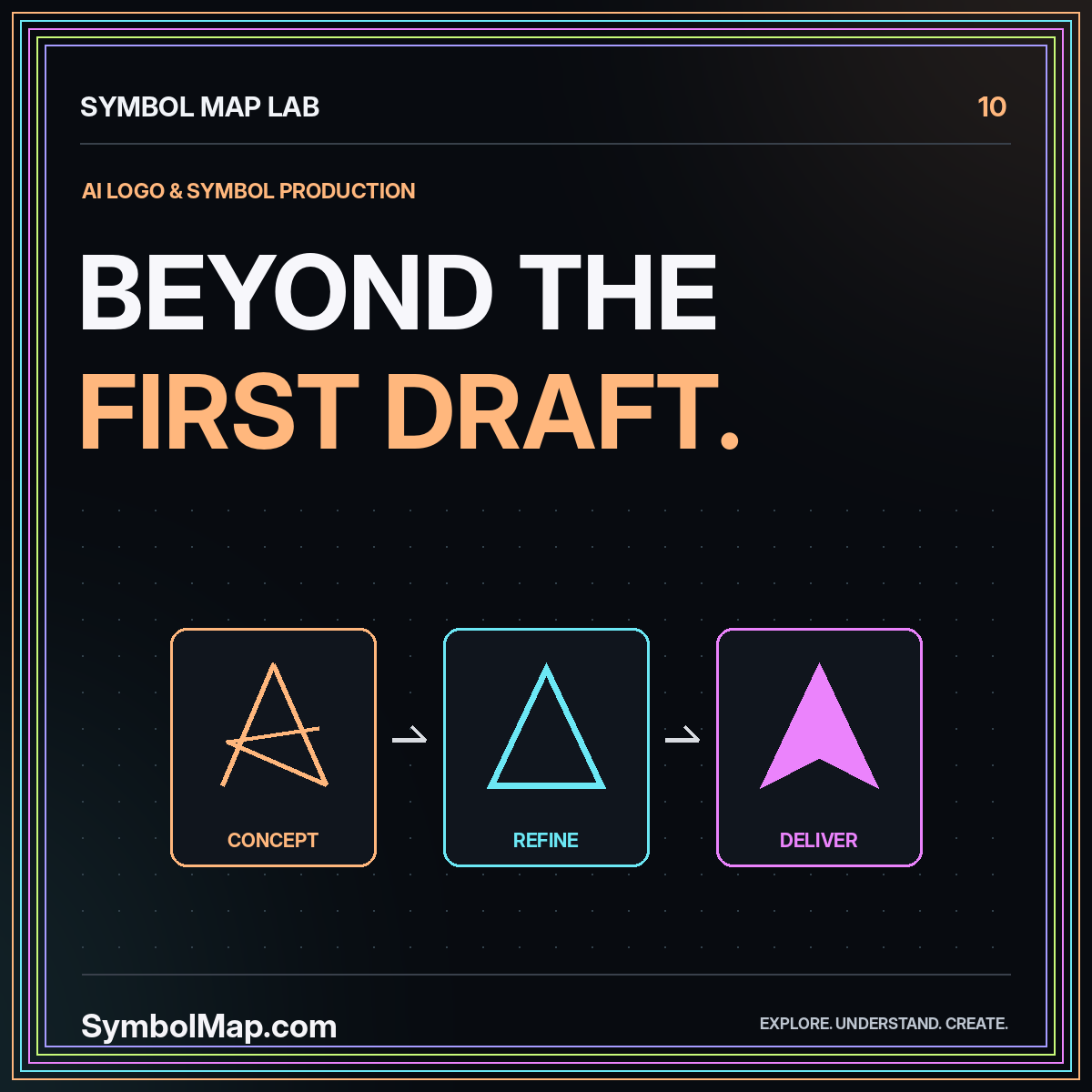
An AI logo maker or symbol generator can help explore a visual direction, but choosing a convincing preview is not the same as finishing an identity. A usable logo needs a clear brief, readable construction, appropriate files, and a review of the actual assets and intended use. Treat generation as one stage in that process.
This guide gives you a practical way to assess a workflow without relying on a vendor ranking or a promise of instant originality. It applies whether you are making an early concept for yourself or preparing options for a fictional client. The central question is what work remains between the generated image and the final deliverable.
Define the deliverable before choosing a tool
Write down what the project needs: a standalone symbol, a symbol plus a wordmark, or a small family of related icons. Specify the smallest intended display size, the required backgrounds, and whether the final artwork must be editable. Those requirements determine which outputs are useful.
A presentation image can be enough for an internal mood discussion. A mark intended for signage, print, and a website requires a more complete handoff. Do not let an attractive mockup quietly redefine the project from “usable identity” to “picture of a possible identity.”
Keep the AI logo maker route for brand-mark planning and the AI symbol maker route for individual motifs or consistent icon families. Their briefs overlap, but the review questions are not identical.
Compare capabilities rather than marketing labels
Inspect what a service actually exports. Does it provide editable paths, a raster image, or both? Can you separate the symbol from the lettering? Are transparent backgrounds available? Does the output preserve the chosen proportions when placed in another application? These are questions to verify in a real sample.
Do not assume that a file extension proves the internal structure. Open the file in the editor you intend to use. A vector container may include a raster image rather than editable geometry. A transparent-looking preview may still contain a painted background. Checking the file is more useful than repeating a product page's headline.
Also review the service's current terms before uploading private client material or using an output commercially. This guide does not assume that different services share the same permissions, retention practices, or subscription conditions.
Write a brief that constrains the form
Describe the subject, geometry, composition, and output purpose. For a fictional repair workshop, a useful direction might be: “An original compact symbol built from two joined open shapes, one-color construction, no lettering, no gradients, readable on a small label.” This gives you observable criteria for reviewing the result.
Avoid prompts that ask for the style of a recognisable brand or instruct the tool to recreate a competitor's distinctive mark. Use the design problem as the starting point. A brief about compactness, continuity, or line construction is easier to develop into original work than a request to imitate a finished identity.
Keep brand lettering separate during early exploration. Add the exact name with editable type in your design workflow, then check spelling and spacing directly. The point is to maintain control over the words rather than hoping a rendered image contains correct final typography.
Generate alternatives with a review question
Create a few directions that differ in structure, not just color. Compare an open shape with an enclosed shape, a single component with a joined pair, or a compact arrangement with a wider one. Record the brief used for each family so the comparison remains understandable later.
Inspect each output against the original requirements. Look for accidental details, unclear intersections, uneven negative space, and elements that disappear at small sizes. Do not excuse a structural problem because the surrounding mockup is polished. The mark must work outside that particular presentation.
The logo symbol mapping article explains how to document these alternatives. A small, labelled comparison board keeps feedback focused on the brief rather than on whichever preview has the most dramatic lighting.
Redraw or refine the approved structure
Once a direction is selected, prepare the actual artwork. Simplify unnecessary components, make joins deliberate, and establish a consistent construction. Retain the approved source file so another designer can edit it without starting from a flattened image.
If tracing is part of the workflow, inspect the result rather than assuming automation has completed the task. Look for excessive points, distorted curves, and small fragments. A file can be technically scalable while still being difficult to edit or reproduce cleanly.
Build the variants deliberately
Prepare a primary version, a reversed version when needed, and a small-size variant if the full construction does not remain clear. Explain which changes are permitted. A variant should be an intentional design decision, not an accidental consequence of shrinking the same picture into every space.
Review rights separately from visual quality
For United States trademark questions, the USPTO's comprehensive clearance guidance recommends checking confusingly similar marks used for the same or related goods and services, including sources beyond federal registrations. That is a different task from deciding whether a generated logo looks distinctive to your team.
A commercial-use permission from a tool should not be treated as a complete clearance decision for the finished identity. Keep a record of the service terms, any incorporated assets, and the relevant review. Specific legal questions need qualified advice in the jurisdictions where the mark will be used.
Do not promise a client that a model-generated concept is guaranteed unique or automatically registrable. This guide provides a workflow checklist, not a determination of rights in a particular design.
Budget for the whole process
When comparing costs, list the tasks rather than inventing a universal price. The project may involve access to a generation service, concept review, vector preparation, typography, asset licensing, rights advice, and export testing. A free preview does not answer what the complete deliverable will require.
For your own planning, separate fixed access costs from revision time. A service can be inexpensive while producing files that take substantial work to refine. Conversely, a narrowly specified project may need only a small amount of assisted exploration. The appropriate budget follows the actual brief.
Ask what happens after the subscription or trial ends. Will you retain the files you need? Are editable sources part of the export? Can the identity be maintained without continuing to use the same service? Verify the current answers before committing to a workflow.
Test the final files in real uses
Place the approved mark on a website header, a small label, and a plain document page when those are part of the brief. Check the actual background colors and available space. A design that works on a dark mockup may need adjustment for a light interface or a single-color print process.
Inspect names and filenames during export. Distinguish the primary mark, reversed mark, symbol-only version, and draft concepts. Include dimensions or intended use where helpful. A clear folder structure reduces the chance that a collaborator publishes an outdated or low-resolution preview.
The symbol generator AI guide provides prompt examples and an output-review checklist. These are resources to use with a separate tool, not a claim that a static reference website processes prompts or generates images on demand.
Deliver a maintainable identity package
Include editable source artwork, the agreed export formats, a concise usage note, and the relevant provenance record. Explain spacing, backgrounds, and any small-size exceptions. The handoff should allow another person to reproduce the identity consistently without needing your entire conversation history.
Keep the rationale brief and specific. Describe the chosen construction and how it answers the brief. Avoid unsupported claims that the shape guarantees trust, higher conversion, or universal recognition. Those are not properties established by creating a polished logo file.
Conclusion: treat the preview as a beginning
AI-assisted generation can support a useful exploration process when the brief and review criteria are clear. The responsible workflow continues through refinement, file inspection, rights review, and real-use testing.
Choose tools based on verified deliverables, not the apparent completeness of a mockup. A strong final identity is one you can edit, explain, and apply consistently—not merely one that looks finished in the first image you receive.
Explore this thread


